Ford Cortina 1600E & 2000E: The Original Executive Cortinas Explained
The Ford Cortina 1600E and 2000E explained by a classic Ford specialist. Mk2 vs Mk3 1600E, 1600E vs 2000E, what to check, what to pay and which executive Cortina to buy in 2026.
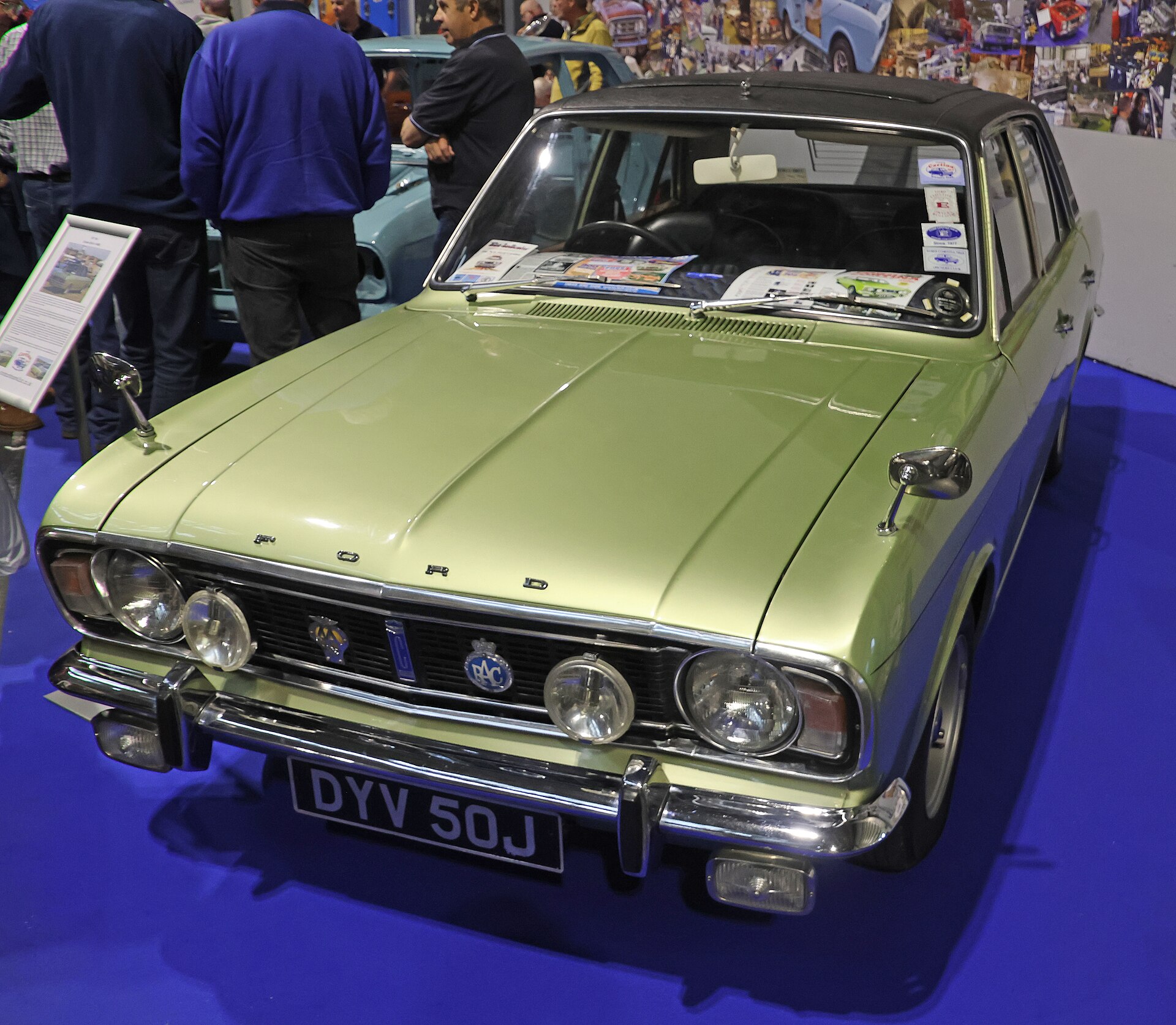
Before the Ghia, there was the E. The Ford Cortina 1600E badge launched in 1967 and ran through to 1973 across two generations of Cortina, defining a new class of British family car: the executive saloon. Wood trim, sports seats, lowered suspension, alloy or Rostyle wheels. The car that gave middle management an aspirational target on a Capri-or-Cortina dealer forecourt. Sixty years on, the 1600E is the most-collected Cortina badge after the Lotus, and the 2000E that succeeded it on the post-facelift Mk3 is catching up faster than most owners realise. After two decades restoring classic Fords at my workshop near Milton Keynes, the E-badge Cortinas are the cars most owners ask about and the ones most likely to be misidentified at the point of sale. This is the specialist’s buyer’s guide — Mk2 1600E vs Mk3 1600E, 1600E vs 2000E, what to check, what to pay, and which executive Cortina to actually buy in 2026.
Where the “E” Came From
The “E” suffix on a Ford Cortina stands for “Executive”. Ford UK introduced the 1600E badge on the Mk2 Cortina in October 1967, slotting above the 1600 GT in the range. The brief was straightforward: a saloon for the manager who couldn’t quite justify the price of a Granada Ghia but wanted a step up from the standard 1600. Lowered suspension from the GT, sports seats from the GT, but with wood trim, plusher carpets, four-spoke wood-rimmed wheel, and Rostyle alloys (Cortina’s first factory alloys). The 1600E was an instant success and ran through to the end of Mk2 production in 1970.
For the Mk3 Cortina, launched October 1970, the 1600E badge migrated to the new Coke-bottle body and continued through to the 1973 facelift. After the facelift, the 1600E was replaced in the executive role by the 2000E — same trim philosophy, larger Pinto engine, more refined manners. The 2000E ran until the end of Mk3 production in September 1976. From the Mk4 onwards, the Ghia badge took over the executive role and the E suffix was retired from the Cortina line.
Mk2 Cortina 1600E (1967 to 1970)
The original 1600E and the collector’s pick of the entire Mk2 Cortina range. Launched at the Paris Motor Show in October 1967 as a four-door saloon. The Mk2 1600E is older, rarer, has more period pedigree than its Mk3 successor, and is the prettier car to most eyes. Production ran from October 1967 to the end of the Mk2 in 1970.
- Engine: 1599cc Kent crossflow, 88 bhp at 5,400 rpm, 96 lb-ft at 3,600 rpm.
- Suspension: GT-spec — lowered springs, stiffer dampers, anti-roll bar.
- Brakes: front discs, rear drums, vacuum servo standard.
- Wheels: 5J × 13-inch Rostyle steel wheels with chrome accents.
- Interior: wood-effect dash, four-spoke wood-rimmed wheel, sports bucket-style seats, deep-pile carpets, full-width door cards.
- Body style: four-door saloon (the original 1967 launch spec, the most common surviving variant).
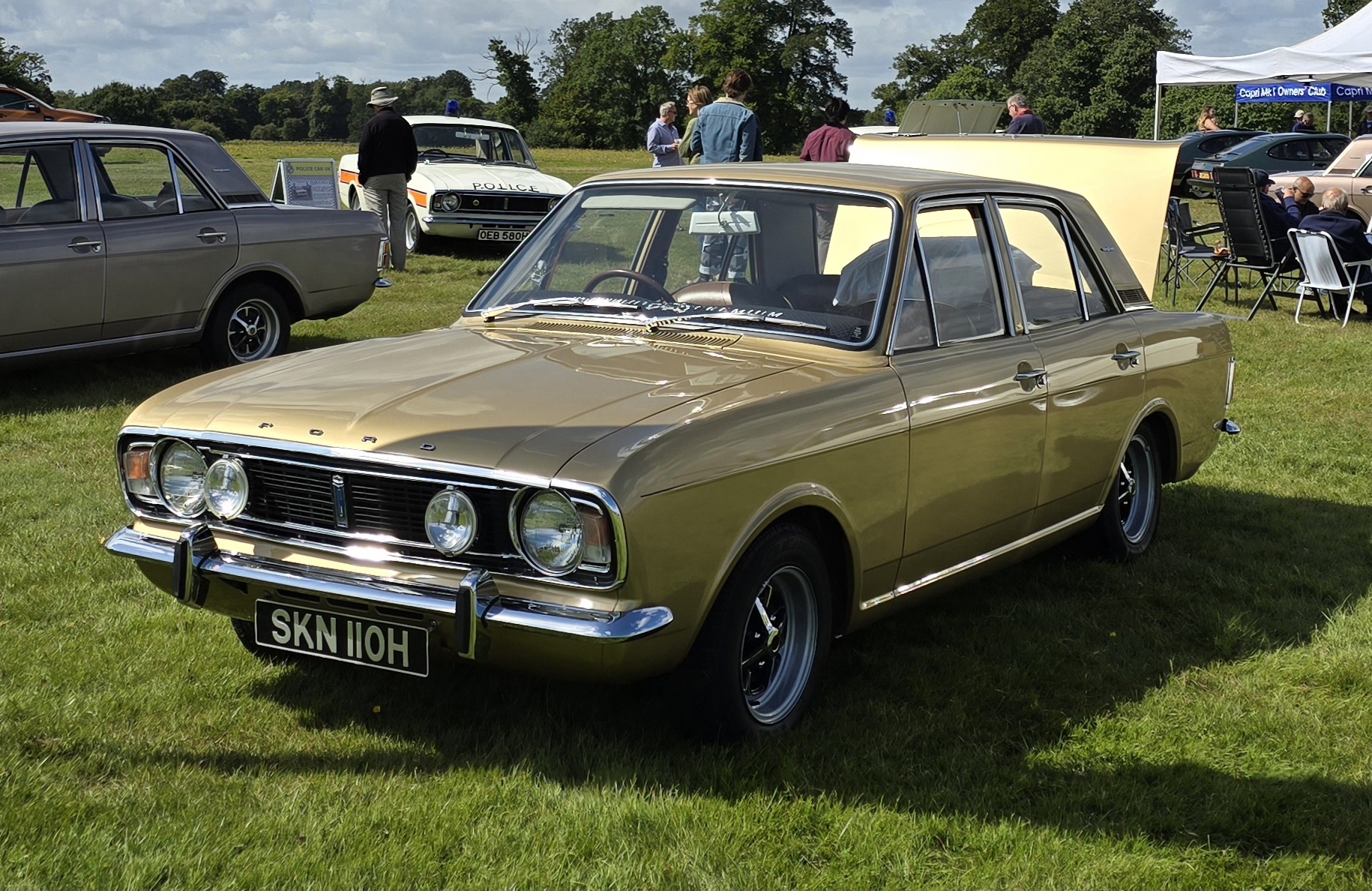
The Mk2 1600E was always sold as a four-door saloon in the UK market — the two-door Mk2 shell was reserved for the GT, Savage and Lotus Cortina variants. That makes the Mk2 1600E unmistakable on body style alone: any “Mk2 1600E” presented as a two-door is a tribute build on a different Mk2 shell, never a factory original.
Mk3 Cortina 1600E (1970 to 1973)
The pre-facelift Mk3 1600E carried the badge across to the new Coke-bottle body. Same Kent crossflow engine, similar GT-spec mechanicals, executive trim, but now with the unmistakable high-waisted Coke-bottle styling and the most-recognised grille design in Cortina history.
- Engine: 1599cc Kent crossflow, 88 bhp at 5,700 rpm.
- Suspension: GT-spec, lowered, anti-roll bar.
- Wheels: 13-inch Rostyles (different pattern from the Mk2).
- Interior: wood-effect dash, four-spoke wood-rimmed wheel, sports seats, vinyl roof on most cars (an option originally but fitted to the majority).
- Body: four-door saloon (the volume body style; estate Mk3s were not offered in 1600E trim).
- Distinctive features: unique 1600E grille design, side stripes, badge on the C-pillar, vinyl roof.
- Build numbers: approximately 57,000 across three years.
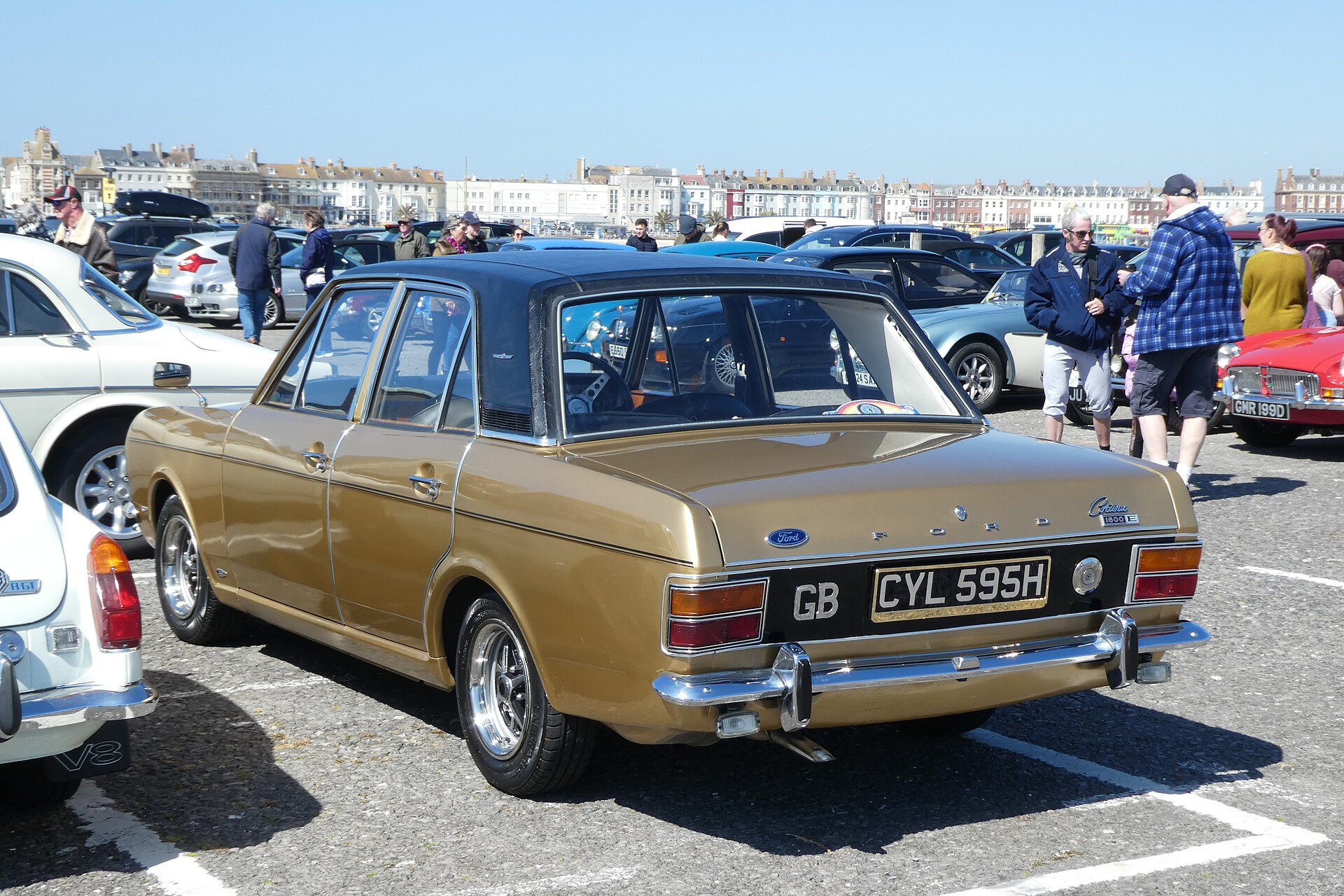
The Mk3 1600E is the single most-faked Mk3 trim. The grille, the wood dash and the Rostyles can all be transplanted onto a 1600 XL shell to make a convincing 1600E spec. The chassis number prefix and Ford’s original build records are the only definitive verification, and the price gap between verified and unverified is substantial — see the verification notes in the Mk3 Cortina buyer’s guide.
Mk3 Cortina 2000E (1973 to 1976)
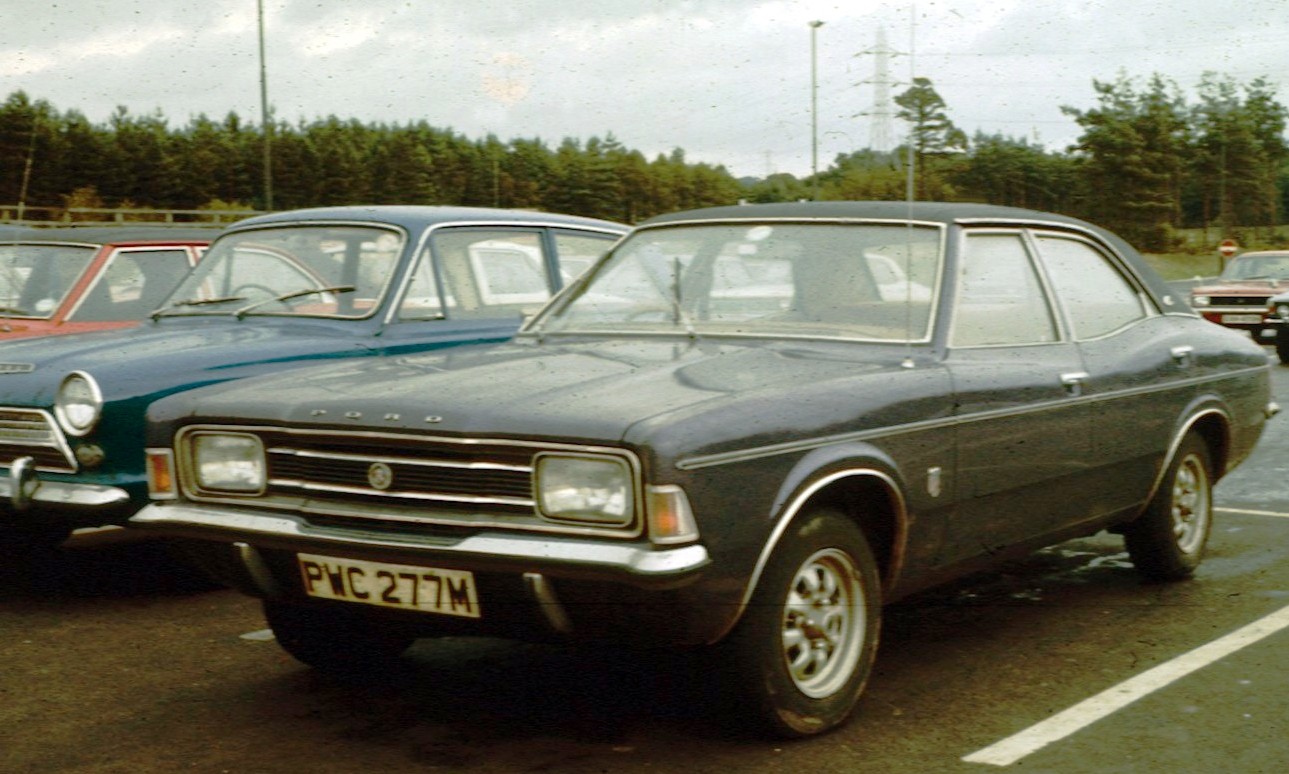
The 2000E took over the executive role after the 1973 facelift. Same trim philosophy as the 1600E — wood dash, sports seats, four-spoke wheel — but with the Pinto 2.0-litre OHC engine, post-facelift Mk3 styling (the larger square headlamps, cleaner grille, wider side mouldings), and a slightly more refined interior.
- Engine: 1993cc Pinto OHC, 98 bhp at 5,500 rpm, 111 lb-ft at 3,500 rpm.
- Transmission: four-speed manual standard, three-speed automatic optional.
- Suspension: GT-spec lowered, uprated dampers.
- Wheels: 13-inch Rostyles, wider pattern than the 1600E.
- Interior: wood dash, sports seats (often velour, sometimes vinyl), four-spoke wheel.
- Body: two-door and four-door saloon, plus estate.
- Distinctive features: 2000E side stripes, badge on C-pillar, larger headlamps, vinyl roof on most cars.
- Build numbers: harder to verify, but roughly 25,000 to 35,000 across three years — significantly rarer than the 1600E.
The 2000E is the more usable executive Mk3. The Pinto pulls cleanly at motorway speeds where the Kent crossflow in the 1600E feels strained. The cleaner late-Mk3 styling has aged well. The 2000E estate is genuinely rare now and increasingly sought-after — values on tidy 2000E estates have climbed faster than the saloons in the last three years.
Mk2 1600E vs Mk3 1600E — Which is the Real Classic?
The honest comparison from someone who’s worked on both.
- Mk2 1600E: older, rarer, more period pedigree, prettier to traditionalist eyes. Four-door saloon body, executive trim, GT-spec mechanicals. Genuinely a “classic” in the pre-1970 sense. Current usable values £15,000 to £22,000. The collector’s pick of the Mk2 range.
- Mk3 1600E: more usable, easier to live with daily, more parts availability, Coke-bottle styling that defines the era. Four-door volume body. Current usable values £12,000 to £18,000. The mainstream pick that holds value better than any other Mk3.
The decision is essentially aesthetic. The Mk2 1600E is the prettier, rarer, more traditionally “classic” car. The Mk3 1600E is the more usable, more available, more Coke-bottle option. Both are good buys; neither is a mistake. The Mk2 has slightly more upside on value because rarity is harder to fake. The Mk3 has slightly more downside risk because of how easily a 1600 XL becomes a 1600E “spec”.
1600E vs 2000E — Which Mk3 is Better?
The other comparison, and the one I get asked most. The 1600E has badge cachet, pre-facelift charm, the unique grille, and the strongest single-trim market in the Mk3 range. The 2000E has the better engine, the cleaner late-Mk3 styling, and significantly more rarity. The price gap between them is narrowing as the 2000E gradually gets recognised for its rarity — but the 1600E still leads on raw money.
- If you’re buying for value-holding: 1600E. The badge premium isn’t going away.
- If you’re buying for use: 2000E. The Pinto is the better engine and the late-Mk3 styling has aged better.
- If you’re buying for rarity: 2000E estate. Few have survived; values are climbing.
- If you’re buying on a tighter budget: 2000E saloon — still cheaper than the 1600E despite being the better car in most respects.
What to Check on an “E” Cortina
Originality is everything on a 1600E or 2000E. The premium that separates a verified original from a “spec” build is substantial. Check in this order:
- Chassis number prefix — verifies the original build spec. The 1600E and 2000E have specific Ford chassis prefixes that don’t match a 1600 XL or 1600 GT.
- The grille — the 1600E grille is unique and worth £400 to £700 by itself. The 2000E grille is the post-facelift wider design with chrome accents. Wrong grille is a giveaway.
- The wood dash — original is wood veneer over a metal carrier. Replacements are often printed plastic or vinyl-wrapped. The wood texture and grain pattern are the tell.
- Sports seats — 1600E and 2000E used specific trim patterns. Cloth or velour on most cars, vinyl on some. A car with the wrong seat pattern hasn’t been restored correctly.
- Rostyle wheels — both trims used specific Rostyle patterns. Period-correct vs aftermarket reproductions matter for value.
- Vinyl roof — if fitted, check underneath. Squeeze along the edges where the vinyl meets the gutter. Squashy means rust underneath and a £1,500 to £3,000 repair.
- Badging — the 1600E and 2000E badges on the boot lid and C-pillar are correct; missing or replaced badges are a flag.
- Original colour — non-original colours cap value. A car repainted in a different shade is fine for a driver but won’t fetch verified-spec money.
Where E-Cortinas Rust
The 1600E and 2000E rust in the same spots as any standard Mk2 or Mk3 Cortina. Full rust patterns by generation are in the Cortina rust guide. The E-specific notes:
- Vinyl roof — the biggest hidden rust risk on any 1600E or 2000E. Water gets under the vinyl, rusts the steel from the top down. £1,500 to £3,000 to put right properly.
- Sills (both generations) — three-layer structural panels. Mk3 inner sills go from inside out. Both sides £2,000 to £3,500.
- Rear arches — Mk2 from the shoulder line down; Mk3 from behind the wheel forward. £500 to £900 per side.
- Inner wings around strut tops — both Mk2 and Mk3. £500 to £1,200 per side.
- Boot floor and spare wheel well — water trap, both generations.
- Fuel filler neck — water gets behind the cap surround.
- 2000E specifically — the Pinto engine mount cross-member rusts under sustained load. £400 to £700 to repair.
1600E and 2000E Values in 2026
Brackets from current UK auction results and private sales. Verified history adds 25 to 40% above the bracket; non-original engine or non-original colour deducts 15 to 25%.
- Mk2 1600E (verified): project £5,500–£10,000. Usable £14,000–£22,000. Restored £24,000–£35,000. Concours £40,000+.
- Mk3 1600E (verified): project £6,000–£10,000. Usable £12,000–£18,000. Restored £20,000–£28,000. Concours £30,000+.
- Mk3 2000E saloon (verified): project £4,500–£8,000. Usable £9,000–£14,000. Restored £15,000–£22,000. Concours £25,000+.
- Mk3 2000E estate (verified): project £5,000–£8,500. Usable £10,000–£15,000. Restored £17,000–£24,000.
- “E-spec” tributes: typically 30 to 50% below the verified bracket. £4,000 to £10,000 for a tidy Mk3 1600 XL built to 1600E spec.
Build vs Buy — The Tribute Question
The 1600E tribute question is identical to the Lotus Cortina tribute question, just at a different price point. A standard 1600 XL Mk3 with a 1600E grille, a wood-dash transplant, sports seats from a donor and a vinyl roof will look like a 1600E from ten feet away. It’ll drive identically. It’ll cost £6,000 to £10,000 to build from a £2,500 1600 XL shell. And it’ll be worth £4,000 to £8,000 when finished — substantially less than the £14,000 to £20,000 a verified original 1600E commands.
The trade-off is the same as on a Lotus Cortina: you get the experience at a third of the money, but you don’t get the value-holding. For a buyer who wants to drive an 1600E without paying 1600E money, the tribute makes sense if it’s bought as a tribute openly. The mistake — and we see this every month at the workshop — is the buyer who pays £15,000 for a “1600E” that turns out to be a tribute on a 1600 XL shell. That buyer has paid verified money for unverified provenance, and the market won’t give it back.
The buying a classic Ford project car guide covers the verification checks that separate the real cars from the tributes before money changes hands. The cost of a proper pre-purchase inspection (£300 to £600) is the cheapest line item in the entire purchase.
Why the E Badge Still Matters
The 1600E was the original aspirational mass-market Ford. The Ghia, the Si, the GTI, the RS — every Ford performance saloon and executive trim that followed traces directly back to the philosophy the 1600E established in 1967. GT mechanicals, executive trim, distinctive badging, a price step above the volume models that justified the upgrade. The badge was Ford’s first crack at the formula that the Capri Brooklands eventually perfected.
The cars I’ve worked on across the E-badge range — Mk2 1600Es, Mk3 1600Es, Mk3 2000Es and 2000E estates — share a common ownership pattern: they were always cherished, always second cars, always kept off the salt. Survival rates are noticeably higher than the standard 1600 XL or 2000 GL on the same body, because owners spent the extra money on the badge and tended to look after the car. That’s exactly why the verified ones are worth what they’re worth, and why a verified 1600E or 2000E from a known owner is the best classic-Cortina buy on the market right now.
If you’re about to buy an E-badge Cortina and want a workshop opinion on the photos, send them through the contact page — chassis plate, engine bay, interior, vinyl-roof edges, sills, arches, boot floor. WhatsApp video walking round the car is even better. We’re classic Ford specialists in Milton Keynes and we’d rather steer you to the verified original than weld you out of the clever tribute six months later. The same care we used on the Capri Brooklands applies to every E-badge Cortina that comes through the workshop.