Lotus Cortina: The Complete Guide to Ford’s Greatest Saloon
Mk1 and Mk2 Lotus Cortina explained by a classic Ford specialist. History, twin-cam engine, Jim Clark, build numbers, authentication, current values and what to check before you spend Lotus money.
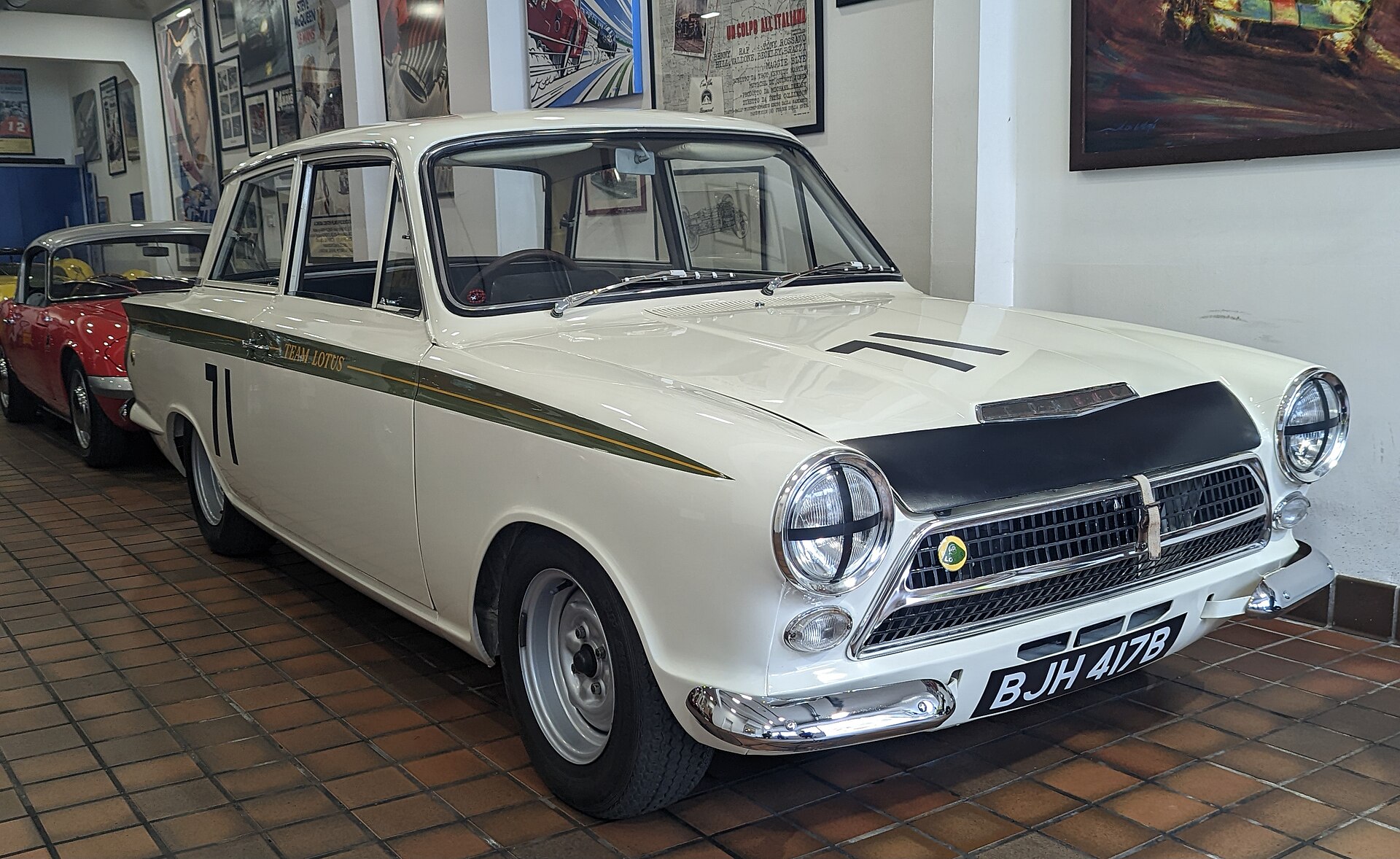
The Lotus Cortina is the most important Ford saloon ever built. It legitimised Ford as a performance brand in Britain, took two British Saloon Car Championship titles (Jim Clark in 1964 and Frank Gardner in 1968) plus the 1965 European Touring Car Championship Division 2 with Sir John Whitmore, and made Jim Clark a household name in three-box racing. Six decades on, an authentic Mk1 Lotus Cortina is worth twenty times what its donor Cortina 1500 cost new, and the Lotus Cortina Register is the difference between a six-figure verified car and a £20,000 tribute. After two decades welding, painting and restoring classic Fords at my workshop near Milton Keynes, the Lotus Cortina is the car that prompts the most questions, the most authentication panic, and the most “is it really worth that” conversations. This is the complete guide — history, spec, racing pedigree, authentication, what to check, and what an honest Lotus Cortina is worth in 2026.
How the Lotus Cortina Happened
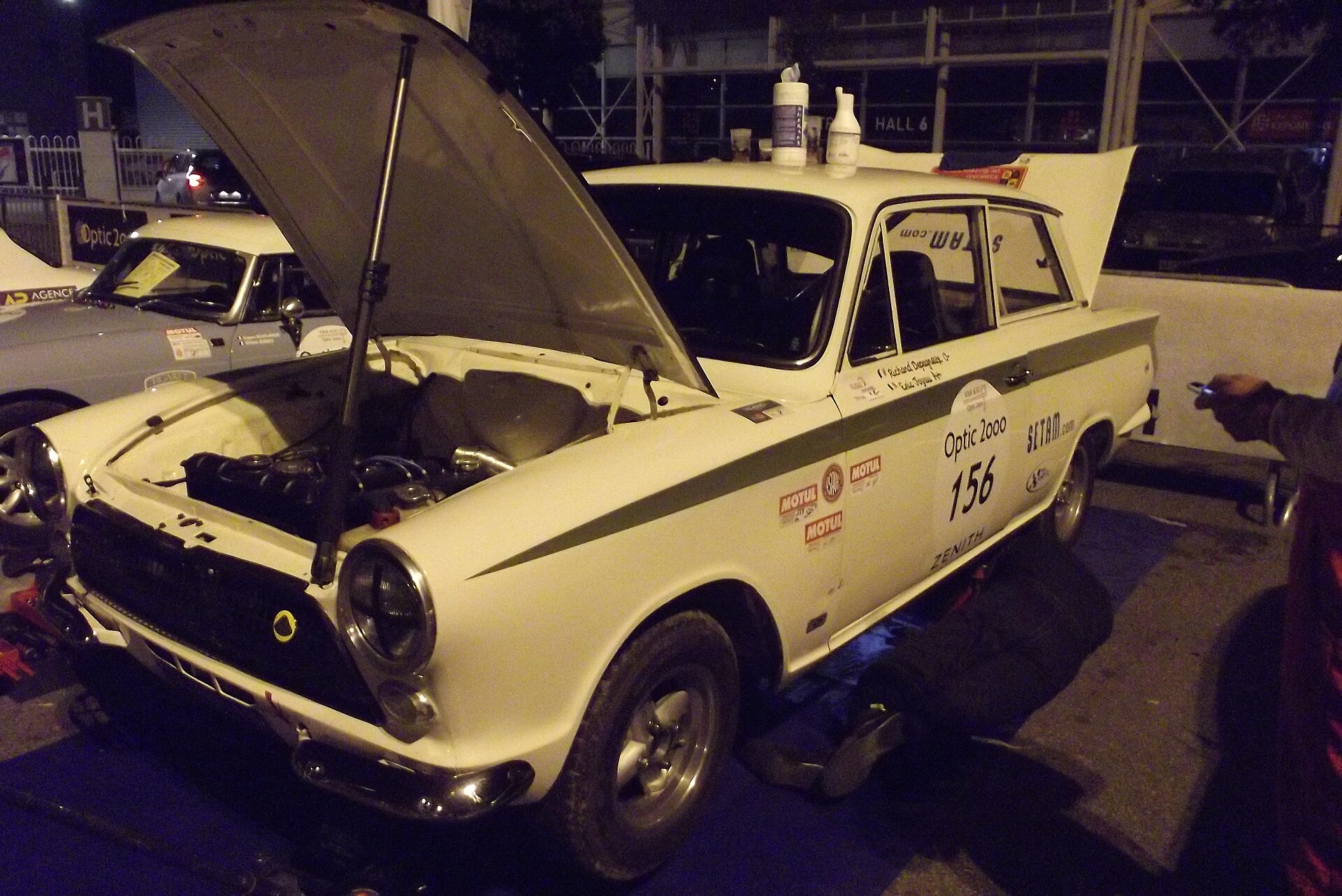
In the early 1960s Walter Hayes, Ford UK’s public affairs director, asked Colin Chapman whether Lotus could build Ford a homologation special — a road-legal saloon car fast enough to win the British Saloon Car Championship. Chapman was building the Lotus Elan and had developed a twin-cam version of Ford’s Kent block for it, with the cylinder head originally designed by Harry Mundy and finalised by Keith Duckworth. The deal that emerged was elegant: Ford supplied two-door 1500 Cortina shells to Lotus, Lotus fitted the twin-cam engine, a stronger close-ratio gearbox, a new coil-spring rear suspension, lightweight aluminium panels and the distinctive Ermine White paint with the Sherwood Green flash, and the finished cars were sold through Ford’s dealer network. Lotus designated the car Type 28.
The first cars appeared in 1963 under the model name “Lotus Cortina” (Ford’s preferred branding) or “Cortina Lotus” (Lotus’s preferred branding — both names are used in period documentation). The 1,000-unit homologation requirement was met within months. By the end of 1963 Lotus Cortinas were beating much faster machinery in the BSCC because of the chassis and the brakes; by 1964 Jim Clark was winning the championship outright. The Lotus Cortina had become Ford’s halo car — and the template for fifty years of Ford performance saloons that followed.
Mk1 Lotus Cortina (1963 to 1966)
The Mk1 is the original, the purist’s choice and the most-faked classic Ford in the UK. It’s also the car that earned the Lotus Cortina its racing reputation. Built between January 1963 and the introduction of the Mk2 body in late 1966, with a major specification change in mid-1965 that splits the Mk1 into “early” and “late” cars.
The Shell
Two-door only — no four-door or estate Lotus Cortina was ever factory built. Lotus took 1500 Cortina shells from Ford and modified them at Cheshunt. The most distinctive change is the colour scheme: Ermine White (Ford colour code 9105) with a Sherwood Green flash running along the flank, terminating in a flick at the rear three-quarter. No other colour combination left the factory until the very end of Mk1 production, when a small number of cars were finished in Bermuda Blue with a white flash for one particular dealer.
Early Mk1s (1963 to mid-1965) got lightweight aluminium panels — boot lid, doors and bonnet — to save weight for racing homologation. These cars are the most sought-after Lotus Cortinas now and the alloy panels are the first thing a verified examination looks for. From mid-1965 onwards, after the rear suspension change (see below), most cars reverted to steel panels because the aluminium was causing warranty problems with the steel-aluminium joints corroding.
The Engine
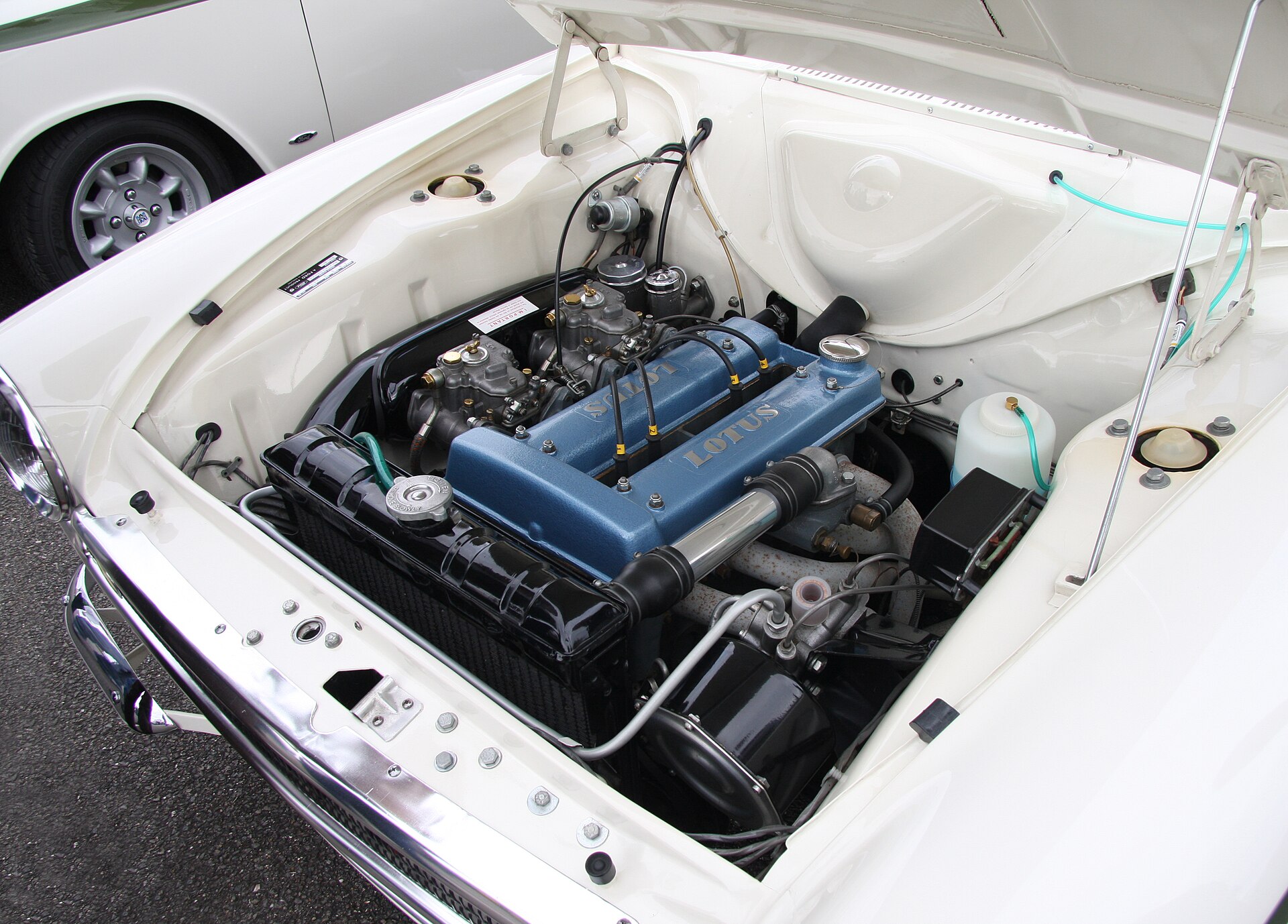
The Lotus-Ford twin-cam is a Lotus-designed twin-cam alloy head bolted to a tall-deck Ford Kent block, with bore and stroke of 82.55 × 72.75 mm for a displacement of 1,558cc (precisely 1,557.46cc, commonly rounded to 1,558cc in period documentation). Twin Weber 40 DCOE carburettors. Output: 105 bhp on the Mk1, rising to 109 bhp on the Mk2. Combined with the close-ratio gearbox and Lotus final drive, the Lotus Cortina would deliver 0–60 in around nine seconds and a top speed close to 110 mph — proper performance-car pace by 1963 saloon-car standards.
The twin-cam engine is the most heavily faked part of the car and the most important to verify. The block has Lotus-specific casting numbers; the head carries Lotus’s “Lotus” cast into the cam covers (originally green, later black); the carb stacks are unique to the Lotus Cortina. A non-original engine — even a properly built twin-cam transplanted later — substantially drops value on a verified car.
The Suspension (and Its Famous Problem)
The early Mk1 (1963 to mid-1965) used a Lotus-developed coil-sprung rear suspension with an A-frame locating the rear axle and a pair of radius arms. It transformed the handling — the racing photographs of Jim Clark cocking the inside rear wheel at full lock are the direct result of this suspension geometry — but the A-frame mounting points on the rear axle and the surrounding bodywork suffered badly under hard use. By mid-1965 Ford had had enough warranty claims to force a change.
From mid-1965 onwards Lotus Cortinas reverted to a more conventional leaf-sprung rear suspension based on the standard Cortina GT. The handling was slightly less special but the reliability was dramatically better. Purist collectors prefer the early coil-sprung cars; pragmatic owners prefer the late leaf-sprung cars. Both are “real” Mk1 Lotus Cortinas, but the early A-frame cars carry a 20 to 30% premium in verified condition.
The Interior
Wood-rimmed steering wheel, sports bucket-style seats, bare-painted dash with a row of auxiliary gauges, four-speed close-ratio gearbox with a remote shifter. Some cars left the factory with the rear seat deleted (for racing homologation purposes, with a homemade carpeted shelf in its place), although most road cars retained the rear seat. Bucket seats were either cloth or vinyl; the cloth ones are rarer and more sought-after now.
Build Numbers
Total Mk1 production is widely cited at 3,306 cars across the three-year run. That figure includes both the early A-frame cars and the late leaf-sprung cars, and includes a small number of right-hand-drive cars exported to Australia, South Africa and other markets. Survivors are estimated in the low thousands worldwide, with most concentrated in the UK. Many surviving cars have been through three or four restorations and the originality of each component is a question worth asking.
Mk2 Lotus Cortina (1967 to 1970)
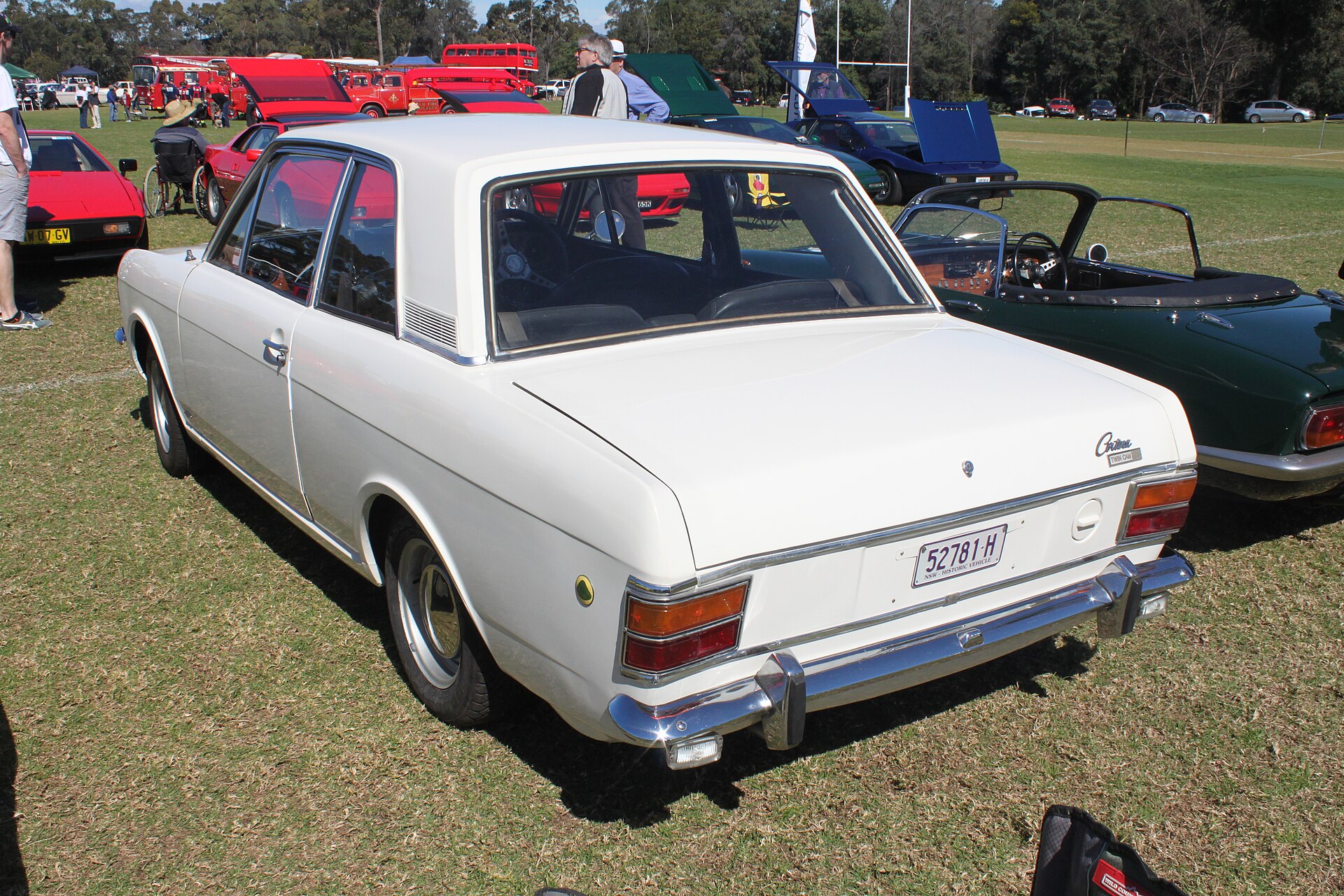
The Mk2 Lotus Cortina arrived in February 1967 on the new Mk2 Cortina body. It’s a more conventional car than the Mk1 in almost every respect: standard steel panels throughout, leaf-sprung rear suspension from launch, refined interior, and a broader colour palette (no longer Ermine White only). The twin-cam engine was retained and lightly refined for the Mk2 — output rose to 109 bhp at 6,000 rpm — and the gearbox was the same close-ratio four-speed.
The Shell
Still two-door only. The Mk2 body is squarer, more conventional, less obviously “special” than the Mk1. Available in any of Ford’s standard Mk2 colours — Ermine White was still a popular choice but Bermuda Blue, Saluki Bronze, Dragoon Red and others were widely sold. The Sherwood Green flash was a no-cost option but most Mk2s left the factory without it.
Build Numbers
Approximately 4,093 Mk2 Lotus Cortinas were built, making it slightly more numerous than the Mk1. The Mk2 was also assembled at Ford’s Dagenham plant rather than at Lotus’s Cheshunt facility — which is why some sources refer to the Mk2 as the “Ford Cortina Twin-Cam” rather than the “Lotus Cortina”, although “Lotus Cortina” was retained for marketing. The Lotus association ended formally in 1970 with the introduction of the Mk3 Cortina, on which no Lotus variant was ever offered.
Why Purists Prefer the Mk1 and Pragmatists Prefer the Mk2
The Mk1 is the original. It’s prettier, it has the racing heritage, and the early A-frame cars are mechanically unique. It’s also harder to find unrestored, much harder to verify, and significantly more expensive at every price point. The Mk2 is more usable, more reliable, more comfortable, and considerably cheaper. The price gap between a verified Mk1 in good condition and a verified Mk2 in good condition is currently around 60 to 100% — meaning a Mk2 buys you two-thirds of the experience for half the money.
Jim Clark and the Lotus Cortina’s Racing History
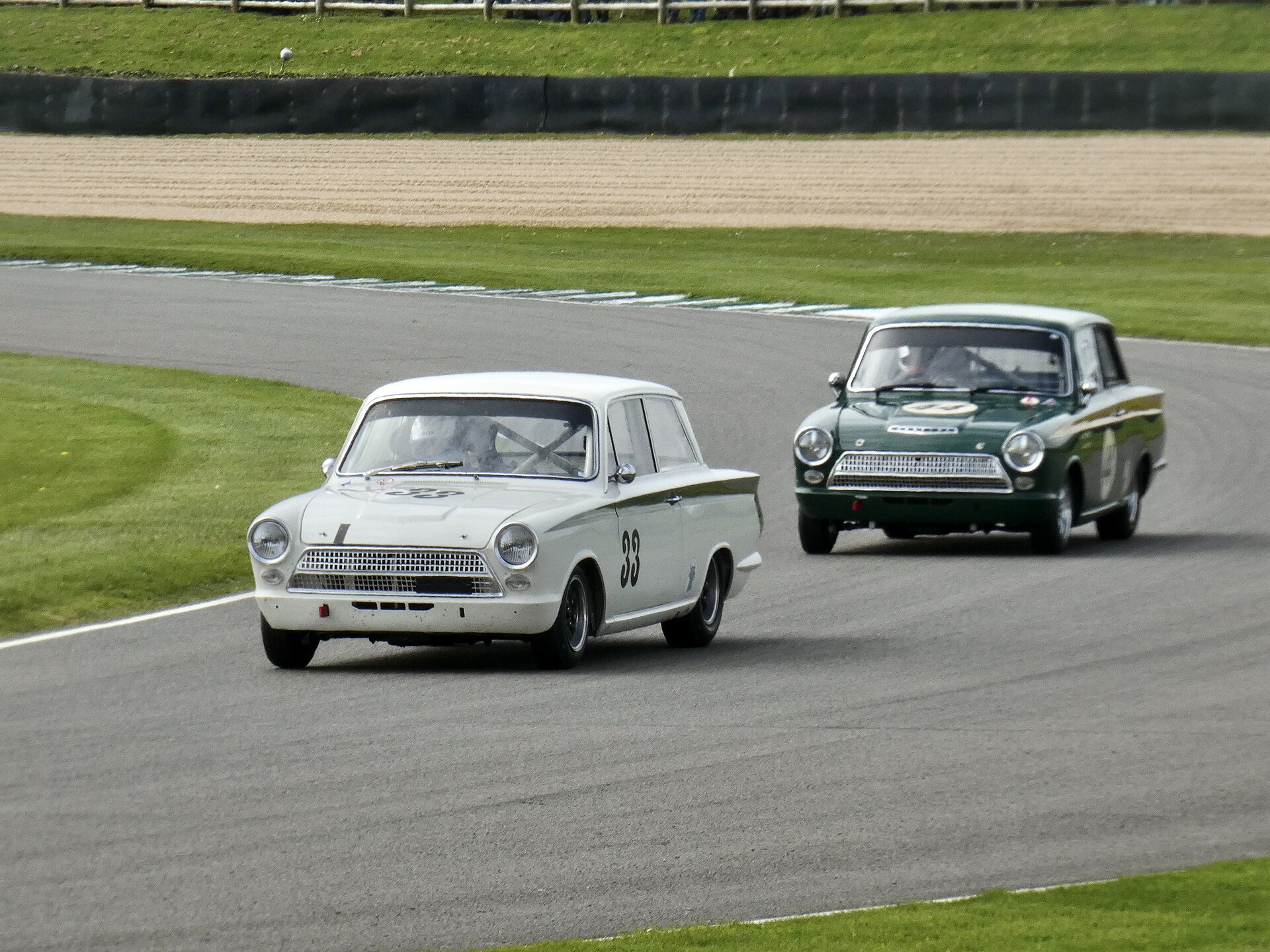
In 1964 Jim Clark won the British Saloon Car Championship outright in a Lotus Cortina, beating much heavier American iron in a 1500cc British four-cylinder. The defining image of that championship — and the image that sold thousands of Lotus Cortinas to enthusiasts who would never see a race track — was Clark cocking the inside rear wheel at full opposite lock through Druids at Brands Hatch. The A-frame rear suspension that caused warranty problems also enabled that handling; lifting the inside rear under hard cornering was a direct consequence of the geometry.
The Lotus Cortina took further competition honours through the mid-1960s. Sir John Whitmore won the 1965 European Touring Car Championship Division 2 in a Lotus Cortina, dominating the international touring-car scene. Frank Gardner took the 1968 British Saloon Car Championship driving a Lotus Cortina alongside a Ford Escort Twin Cam — the second BSCC title for the Lotus Cortina nameplate. The cars were also widely campaigned in European production-class racing, including a class win and fourth overall at the 1964 Tour de France Automobile by a Boreham-prepared example. For a saloon car of its era, the Lotus Cortina built a competition record that few Fords have matched since — only the RS500 Sierra Cosworth and the works Escort RS programmes come close.
The racing pedigree is also why the car’s authentication matters. A Lotus Cortina with a verified racing history (period-correct race entries, photographs in period, FIA papers) is worth substantially more than a road-spec example. Conversely, a “racing history” Lotus Cortina with no documented evidence is just a heavily-modified road car — and there are plenty in circulation.
Authentication — The Single Most Important Section
The Lotus Cortina is the most-faked classic Ford in the UK and the most consequential to verify because the gap between a real one and a tribute is six-figure money. The market splits into three categories: verified original cars (highest value), recently restored cars with verified chassis (next tier), and “Lotus-spec” tribute cars built from 1500 GT shells (entry point). Telling them apart requires several specific checks.
Chassis Number and Plate
Every Lotus Cortina carries a Ford chassis number on a plate riveted to the inner wing and matched by a stamping on the bulkhead. The prefix denotes the model variant: Lotus Cortinas used a Lotus-specific identifier that differs from the standard 1500, 1500 GT and Super shells. If the chassis plate doesn’t match the bulkhead stamping, the car has been re-shelled or rebadged. The Lotus Cortina Register holds the definitive UK list of original chassis numbers, build dates and original specifications — any serious purchase should be verified against the Register’s records before money changes hands.
Mk2 Lotus Cortinas use a different Ford chassis numbering format reflecting the Dagenham-assembled production. Again the Register holds the original production records and is the authoritative verification source.
Lotus-Specific Stampings
The close-ratio gearbox carries Lotus-specific identification on the casing. The rear axle carries a code denoting the Lotus final drive ratio. The original twin-cam engine block has a specific casting number prefix and the cylinder head carries “Lotus” cast into the cam covers (originally painted, with the colour varying by production run). All of these markings can be cross-checked against Lotus Cortina Register records as part of any verification process.
Paint and Trim Originality
Original Mk1 paint is Ermine White (Ford 9105) with Sherwood Green flash. The flash has a specific shape, width and termination point that a properly restored car will match; cheap copies miss the flick at the rear three-quarter or get the width wrong. The interior trim pattern, the dash gauges, the steering wheel and the gearknob all have specific patterns that the Register can verify from period photographs and parts records.
The Lotus Cortina Register
The Lotus Cortina Register (lotuscortinaregister.com) holds the definitive UK record of verified Lotus Cortina chassis numbers, build dates and original specifications. Register membership and a Register verification certificate are now effectively required for any Lotus Cortina sale above £40,000 — without them, a car is treated as “claimed-spec” rather than “verified”, and prices reflect the difference. The Register also tracks ownership changes and provenance, which is increasingly the deciding factor in any high-value sale.
Common Tribute Conversion Routes
A significant proportion of “Lotus Cortinas” in private circulation are not factory original. The common conversion paths to be aware of:
- 1500 GT shell rebuilt with Lotus twin-cam, Lotus colours, Lotus interior. Looks identical from ten feet; the chassis number and Register check give it away.
- Standard 1500 shell rebuilt to similar spec. Same issue — the chassis prefix is the giveaway.
- Genuine Lotus Cortina shell with non-original engine (modern twin-cam rebuild or Lotus engine from a different car). The shell is real but the engine is not — affects value by 25 to 40%.
- Re-shelled Lotus Cortina: original chassis plate transferred to a different shell after accident damage. Hardest to spot but Register inspection picks it up.
- Mk2 Lotus claimed to be a Mk1: rare but happens at the entry end of the market — a Mk2 chassis plate can be transferred to a Mk1 shell with the right paperwork.
A verified Mk1 Lotus Cortina is worth two to three times an unverified one of identical visual condition. The cost of Register inspection (around £300 to £500) is the best value spend in classic-Ford buying.
Where Lotus Cortinas Rust
The Lotus Cortina shell rusts in all the places a standard Mk1 or Mk2 Cortina rusts, plus a few that are unique to the Lotus variant. The Cortina rust guide covers the saloon-shell pattern in full; the Lotus-specific additions are:
- Steel-aluminium joints on early Mk1 cars — where the aluminium boot, doors and bonnet bolt to the steel structure. Galvanic corrosion eats both metals. Repair requires removal of the aluminium panel, treatment of the steel underneath, and reassembly with new isolation washers. £400 to £800 per joint.
- A-frame mounting points (early Mk1 only) — load-bearing points on the rear axle housing and on the bodywork. Rust here is structural and dangerous. £600 to £1,200 to repair properly.
- Inner wings around the strut tops — same as a standard Cortina but worse here because the twin-cam engine carries more weight than the 1500.
- Front cross-member around the engine mounts — twin-cam carries more weight and stress than the standard engine. Cross-member rot is more common on Lotus shells. £500 to £1,000.
- Sills (inner and outer) — same three-layer pattern as the standard Cortina. £2,000 to £3,500 for proper restoration both sides.
- Boot floor around the spare wheel well — water trap, same as a standard Cortina.
- Rear axle suspension mounts — leaf-sprung cars suffer less than the early A-frame cars but still need careful inspection.
What to Check Mechanically on a Lotus Cortina
- Twin-cam engine — oil pressure cold and hot (should be 50+ psi cold, 30+ at idle hot). Valve clearances (the twin-cam needs regular adjustment; neglected ones burn exhaust valves). Head gasket history — twin-cam heads can warp under sustained high revs. Top-end rebuild typically £4,000 to £6,000; full engine rebuild £8,000 to £12,000.
- Carburettors — twin Weber 40 DCOEs. Synchronisation, float levels, jetting. Reconditioning a pair is £600 to £1,000.
- Close-ratio gearbox — synchromesh on second and third are the first to go. Whine in third or fourth means worn layshaft bearings. Rebuild £1,500 to £2,500.
- Rear axle — original 3.9:1 final drive. Whine on overrun means worn pinion bearings.
- Front uprights and king pins (Mk1 early) — wear out, need regular greasing. A Lotus Cortina with stiff steering usually means seized king pins.
- Steering — recirculating ball, generally robust but needs regular adjustment.
- Brakes — front discs, rear drums. Servo-assisted on most cars. Master cylinder and servo are common failure points.
Lotus Cortina Values in 2026
Brackets, not exact figures, because verification status, originality, race history and provenance all shift the totals dramatically. These figures are current as of early 2026 and reflect UK auction results and verified private sales.
- Mk1 verified, early A-frame, original engine, original colour, documented history: £75,000 to £130,000. Concours, period race history £150,000+.
- Mk1 verified, late leaf-sprung, original engine: £55,000 to £85,000.
- Mk1 verified, non-original engine or off-original colour: £35,000 to £55,000.
- Mk1 “Lotus-spec” tribute (1500 GT shell, real twin-cam): £20,000 to £35,000.
- Mk2 verified, original engine, good condition: £30,000 to £55,000.
- Mk2 verified, restored to high standard: £45,000 to £70,000.
- Mk2 “Lotus-spec” tribute: £15,000 to £25,000.
- Project Mk1 (Register-verified shell, complete but needs everything): £25,000 to £45,000.
- Project Mk2 (verified shell): £15,000 to £25,000.
Note that a verified Mk1 with documented Jim Clark-era race history (period FIA papers, period photographs, identifiable period results) sits in a different price bracket entirely — sales above £250,000 are not unusual for the right car with the right story. Most Lotus Cortinas don’t have that history; the ones that do are the trophy cars of the classic-Ford market.
Restoring a Lotus Cortina — What’s Involved and What It’ll Cost
A bare-shell restoration on a verified Mk1 Lotus Cortina typically runs £45,000 to £75,000 in workshop costs alone, before parts, paint and engine work. Add a twin-cam rebuild (£8,000 to £12,000), Weber reconditioning (£800), gearbox rebuild (£2,000), interior retrim (£4,000 to £6,000), wheels, brakes, suspension components, and the all-in figure on a concours-spec restoration regularly hits £90,000 to £120,000. That’s why a project Mk1 at £25,000 to £45,000 is a starting price, not a finished price.
For most owners, a sympathetic restoration that keeps the car usable while preserving originality — repaint, mechanical refresh, interior refurbishment, structural welding where needed — is a more sensible approach than a full ground-up concours rebuild. £30,000 to £55,000 will keep an honest Mk1 on the road for the next twenty years; the concours-spec restoration is for the buyer who’s positioning the car at the top end of the market and needs documented verified provenance. The full breakdown of what each level involves and where the money goes is in the Ford Cortina restoration cost guide.
Buying a Real One vs Building a Tribute
The eternal question, and one I get asked monthly. The economics are stark: a verified Mk1 Lotus Cortina is £55,000 to £130,000. A well-built Mk1 1500 GT tribute on a verified non-Lotus shell, fitted with a properly rebuilt twin-cam, correct Lotus paint and trim, is £25,000 to £40,000 — and drives identically to the real thing.
The originality argument matters if you’re buying for value-holding, for show, or for the trophy of ownership. The “I just want to drive a Lotus Cortina” argument matters if you’re buying for the experience. Both arguments are valid; the worst mistake is buying an “unverified Lotus Cortina” at verified prices — that’s the position from which you can’t win, because the moment the Register can’t verify it, the value drops to tribute money. Either pay for verified provenance, or build a tribute openly. Don’t pay verified money for unverified provenance.
If you’re considering the tribute route, the same shell-condition rules apply that we cover in the buying a classic Ford project car guide. A scruffy real 1500 GT shell on a sound floor is a better starting point than a “tidy” project that’s hiding rust under filler — particularly because you’re going to be spending heavily on the engine and trim, and you don’t want to be welding the structure at the same time.
We’ve Worked on These. Here’s What We’ve Learned
The Lotus Cortina is one of those cars where the value of doing the work properly is measurable in real money. The same care we’d take on a Capri Brooklands — verifying every chassis number, cross-referencing every part against the originality records, only welding in fresh steel rather than patching — pays back ten times on a verified Lotus Cortina because the market punishes any compromise on originality.
What we’ve learned across the Lotus Cortinas that have come into the workshop: every car that arrives with documented history takes a third of the time to assess that an undocumented car does. Every car with a verified Register entry sells for almost twice the money of an identical-looking unverified one. And every “matching numbers” car with paperwork sells for more than every “looks correct” car without.
If you’re about to buy a Lotus Cortina and want a workshop opinion before you commit, send photographs through the contact page — chassis plate, bulkhead stamping, engine bay, gearbox tag, rear axle, plus the usual rust spots from underneath. Better still, take the car to a Register-approved inspector before the money changes hands. The £400 spent on verification is the cheapest insurance in the entire purchase. We’re classic Ford specialists in Milton Keynes and we’d rather see you in a real Lotus Cortina than out of pocket on a clever tribute.