Ford Escort Eclipse, Serenade & Harrier: The Forgotten Specials Explained
Three Ford Escort special editions almost nobody covers properly. A classic Ford specialist walks through Eclipse, Serenade and Harrier — what they were, what makes them different, what they're worth.
Ford UK was the king of the special edition. Through the late 70s, 80s and 90s, the Escort range was kept alive by a continuous churn of limited-run trim packages — Harrier, Eclipse, Serenade, Cabaret, Casino, Calypso, Bonus, Popular Plus, Encore. Some were genuine collector cars. Some were stickers on a base shell. All of them are now disappearing fast, often unrecognised. After twenty years as a classic Ford specialist at my workshop near Milton Keynes, I’ve worked on enough of these forgotten Escorts to know which are worth saving and which to leave to the scrapyard. This is the guide to Ford Escort Eclipse, Serenade and Harrier — three special editions almost nobody covers properly.
Why Ford UK Built So Many Escort Special Editions
The Mk2 and Mk3 Escort ranges aged through the early 80s. The Mk4 was a holding-pattern facelift, the Mk5 of 1990 was widely panned at launch. Ford UK’s marketing strategy across this period was the constant special edition: dealer-led trim packages with distinct names, fitted to the existing range, that gave the showroom something new to advertise every six months.
Most were built in production runs of 1,000 to 5,000 cars. Some were genuinely unique (Mk2 Harrier, with its black-and-gold scheme). Some were stickers and alloy wheels on base cars. All of them were treated as disposable for decades — which means most have been scrapped.
How to Tell a Real Ford Escort Special Edition from a Re-Badged Base Car
- Check the build plate — most special editions had a specific trim code stamped on the build plate or VIN sticker. Match the trim code to period sales brochures.
- Cross-reference the V5 — special editions usually carried the edition name on the V5 (e.g., “Eclipse” in the model designation field).
- Period sales brochures — the Ford UK Heritage archive (and various enthusiast websites) have most period brochures online. Match the car spec to the brochure.
- Dealer documentation — original first registration documents and dealer invoices, where they survive, confirm spec at point of sale.
The honest reality: some special editions were stickers and trim on standard shells, and that’s fine. But pretending a base-spec car is a special edition hurts value when buyers spot it. Documentation is what separates a real Harrier from a Black Mk2 Escort someone has thrown gold stripes at.
Ford Escort Mk2 Harrier (1979)
The most desirable of the three by some margin. The Mk2 Harrier is now a genuinely collectable late-Mk2 special — values have climbed steadily since 2015 and continue to do so.
- Production: 1,500 total — 1,000 in Diamond White and 500 in Strato Silver
- Introduced: December 1979 (production ceased spring 1980)
- Mechanical spec: based on the 1600 Sport — no engine upgrades over standard
- Distinguishing features: Diamond White or Strato Silver bodywork with three-tone blue body stripes, RS alloy wheels, boot spoiler, spot lamps, bronze-tinted glass, remote-control door mirror
- Trim: Recaro seats trimmed in black “Beta Cloth”, push-button LW/MW radio
- Value 2026: Project £3k–£6k. Driver £8k–£14k. Concours £16k–£22k.
The Harrier had no mechanical upgrades over the 1.6 Sport it was based on. It commemorated an Escort winning the Lombard RAC Rally for the eighth successive year — celebration trim package, not a rally homologation. The appeal is the look, the rarity (only 1,500 built), and the late-Mk2 collector status. Strato Silver examples carry a slight premium over Diamond White because only 500 were built; original-paint examples in either colour carry meaningful premiums over respray cars.
Ford Escort Mk4 Eclipse (1990)
- Year: 1990 (Mk4 runout, discontinued September 1990 when the Mk5 launched)
- Mechanical spec: 1.3 OHV, based on the 1.3 LX trim
- Body styles: three-door and five-door hatchback
- Colours: Amalfi Blue or Flambeau Red only
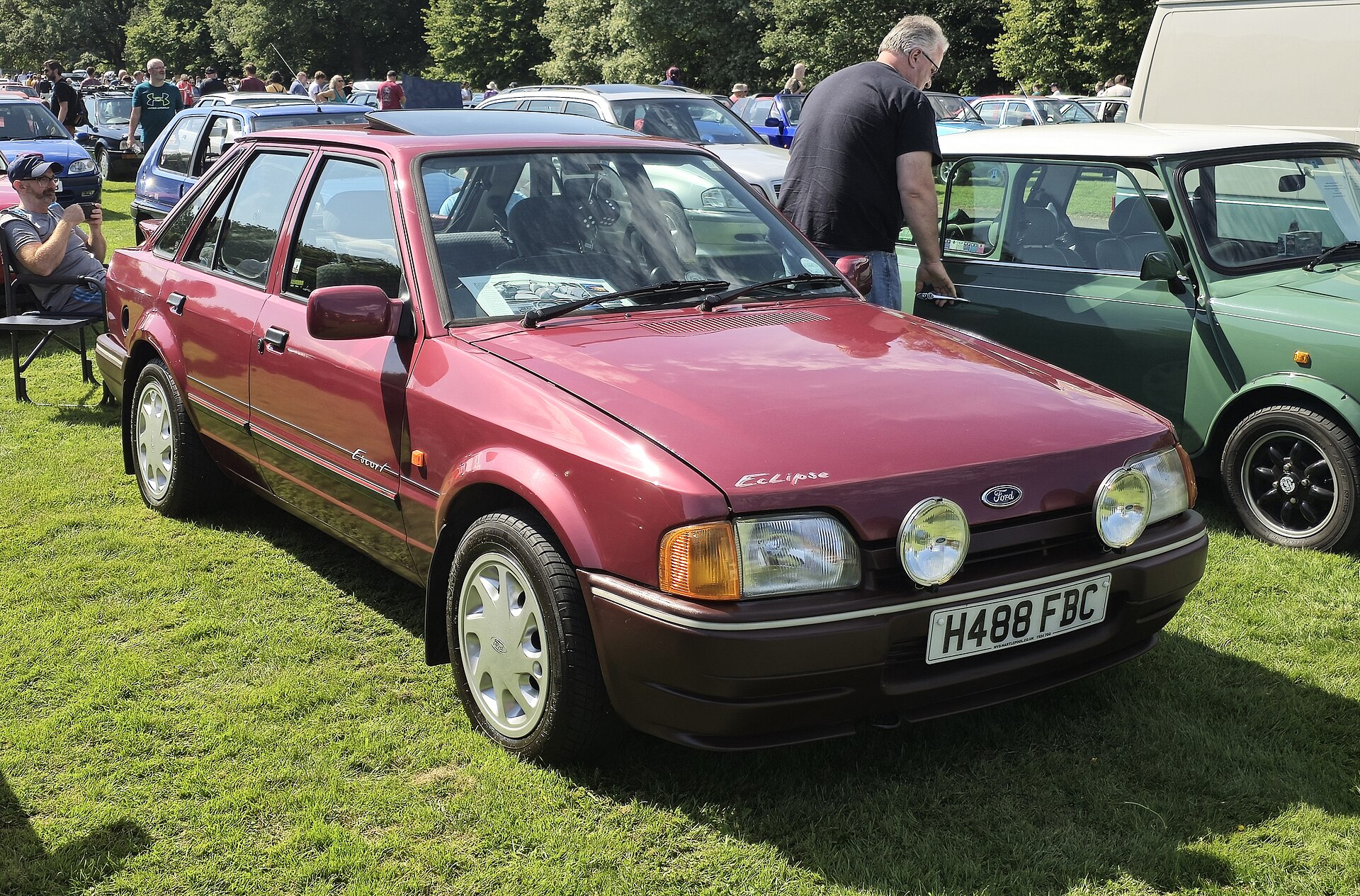
- Distinguishing features: Eclipse-specific side graphics, alloy wheels, upgraded trim over base LX
- Production: not publicly documented — treat any quoted figure as unverified
- Value 2026: Project £400–£1,500. Driver £1,500–£3,500. Tidy/unmodified £3,500–£6,000.
The Eclipse is currently almost worthless. That’s exactly when interest in cars like this starts to climb — the same pattern that pulled Mk2 Harrier values up over the last decade. A clean Eclipse with original graphics, original alloys, original colour and a documented history is now an emerging-classic punt. The Mk4 shell shares rust issues with the late Mk3/Erika platform — sills, rear arches, scuttle. See the Ford Escort rust guide.
Ford Escort Mk5/5b Serenade (early 1990s)
- Era: Mk5 / Mk5b facelift, early 1990s (exact production window not independently confirmed)
- Mechanical spec: small-capacity petrol — period brochure verification recommended on any individual car (Mk5b cars overlap the CVH-to-Zetec transition, so engine spec varies)
- Distinguishing features: typical Ford UK trim-package fare — body-coloured bumpers, alloy wheels, sunroof and Serenade-specific seat fabric, per period dealer literature
- Aimed at: the lifestyle / first-car market — Ford UK’s response to softer marketing-led trim packages from Vauxhall and Peugeot
- Value 2026: Project £300–£1,000. Driver £1,000–£2,500. Tidy £2,500–£4,500 (specialist estimate — too few transact publicly for a hard market)
The Serenade is quietly disappearing. Most went to first-time drivers, got thrashed, then scrapped. The few that survive are increasingly recognised as period-correct early-90s Escorts — but the market hasn’t caught up yet. Spec details on Serenades are thinly documented; if you’re buying one, ask for the original brochure or dealer paperwork to confirm trim against your car.
What to Check on a Ford Escort Special Edition
- Mk2 Harrier specifically: original three-tone blue stripes (often replaced or repainted over — original-pattern stripes carry a premium), RS alloy wheels, boot spoiler and spot lamps present, bronze-tinted glass intact, original Recaro seats in Beta Cloth, Mk2 rust spots — see the general Escort rust guide.
- Eclipse (Mk4): original Eclipse graphics intact (replacements are scarce), original Amalfi Blue or Flambeau Red paint, rear arch rust, sills, scuttle, original alloys present.
- Serenade (Mk5/5b): original graphics and badges, body-colour bumper fading from sun damage, sunroof drains and water ingress, rear arch rust, front subframe mount rust.
- All three: originality of trim, presence of edition-specific badges, original alloy wheels, dealer documentation, V5 designation matching brochure spec.
Restoring a Forgotten Ford Escort Special — Is It Worth the Money?
Honest answer. A Mk2 Harrier with original RS alloys, intact three-tone blue stripes, decent paperwork and a sound shell is worth restoring. Even at £18k restoration cost, the finished car can sit at £15k to £22k — close to breakeven, plus you have the car. The Harrier market is rising, especially for Strato Silver cars (only 500 built versus 1,000 Diamond White).
A Mk5 Eclipse with rotten subframe mounts and faded graphics probably isn’t. £8k restoration on a car worth £4k finished doesn’t make sense. The exception: if it’s your first car, your dad’s car, or one with personal history — then the financial maths is irrelevant.
The general rule: originality matters more than rarity on these cars. A 95%-original Eclipse with original graphics is worth restoring. A 60%-original Harrier with replaced trim and a respray is harder to justify. The Escort restoration cost guide covers what restoration actually costs at each level.
Other Forgotten Ford Escort Specials Worth a Look
- Mk3 specials: Cabaret, Bonus, Popular Plus
- Mk4 specials: Eclipse, Casino, Calypso
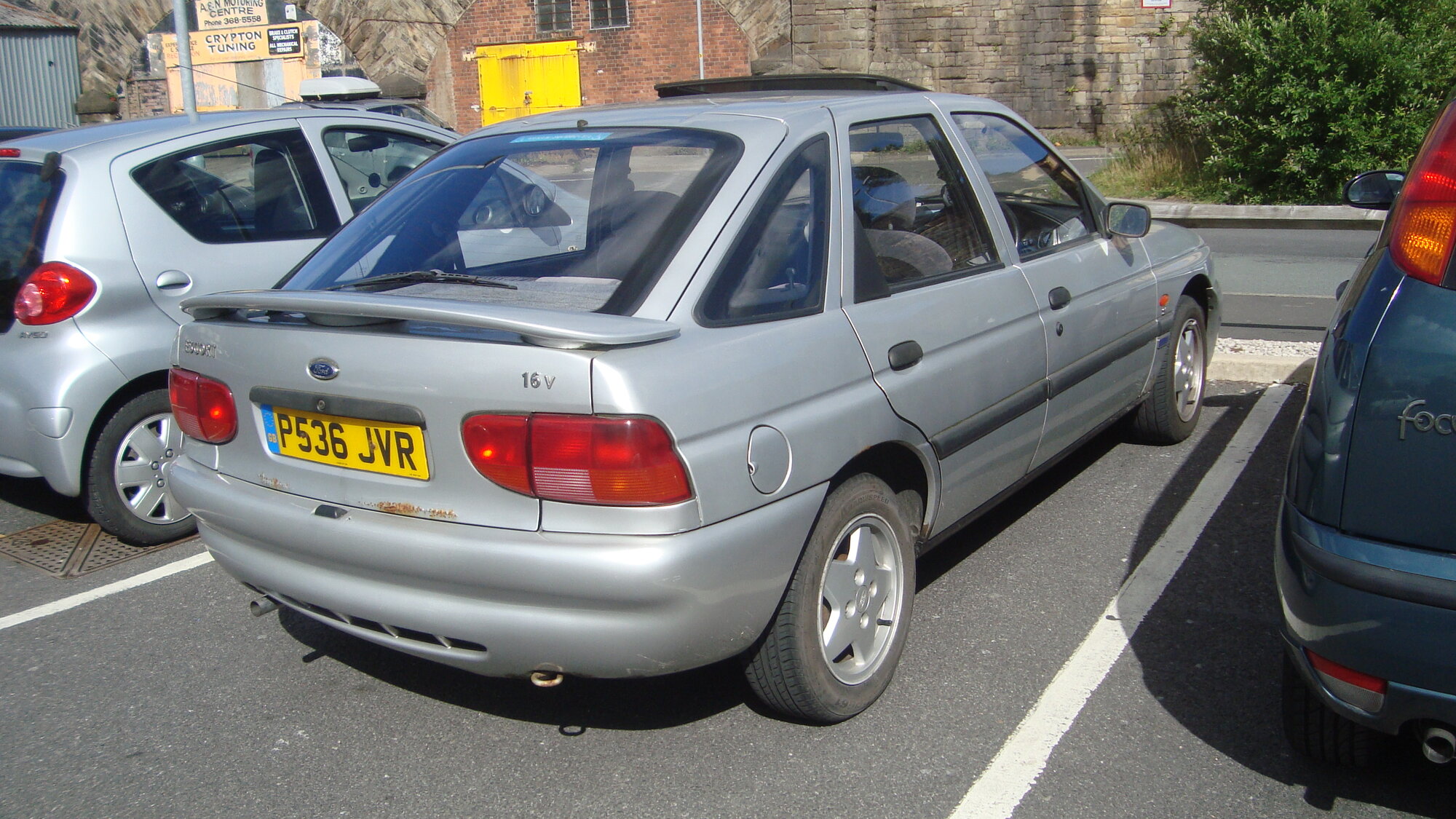
- Mk5/Mk5b specials: Serenade, plus the Cabriolet special editions
- Mk6 specials: Encore, Finesse, Cabaret (1997 onwards), Mexico-badged late entry-level cars (not real Mexicos)
Future posts will cover each in detail. The point for now: any of these in original condition with documentation is increasingly interesting. They’re cheap to buy, cheap to restore (relative to RS Escorts), and they tell the story of how Ford UK kept the Escort line alive across three decades.
The “Buy a Forgotten Special Now While They’re £2k” Thesis
The Mk2 Harrier was £800 in 2010. £4,000 in 2018. £10k+ today for a clean example. The pattern repeats. Today’s £1,500 Eclipse in tidy original condition is tomorrow’s £6,000 to £10,000 emerging classic. Today’s almost-worthless Mk6 Cabaret may follow.
Not every forgotten special will appreciate. But the pattern of period-original survivors becoming emerging classics is consistent across the Escort range, the Capri range (see Ford Capri special editions), and the broader UK classic market.
If you’ve got a forgotten Escort special — Harrier, Eclipse, Serenade, or anything else from the special-edition catalogue — and you want a specialist opinion on whether it’s worth restoring or selling, I’m happy to have a look. Send me photos on WhatsApp and I’ll tell you straight. For the wider context see the RS models guide (the headline acts of the range) and the classic Ford specialists page for everything else I cover.