Ford Escort RS Turbo Series 1 vs Series 2: Which One Should You Buy?
Series 1 or Series 2 Ford Escort RS Turbo? A classic Ford specialist breaks down the differences, values and which to choose for daily driving, weekend fun or investment.
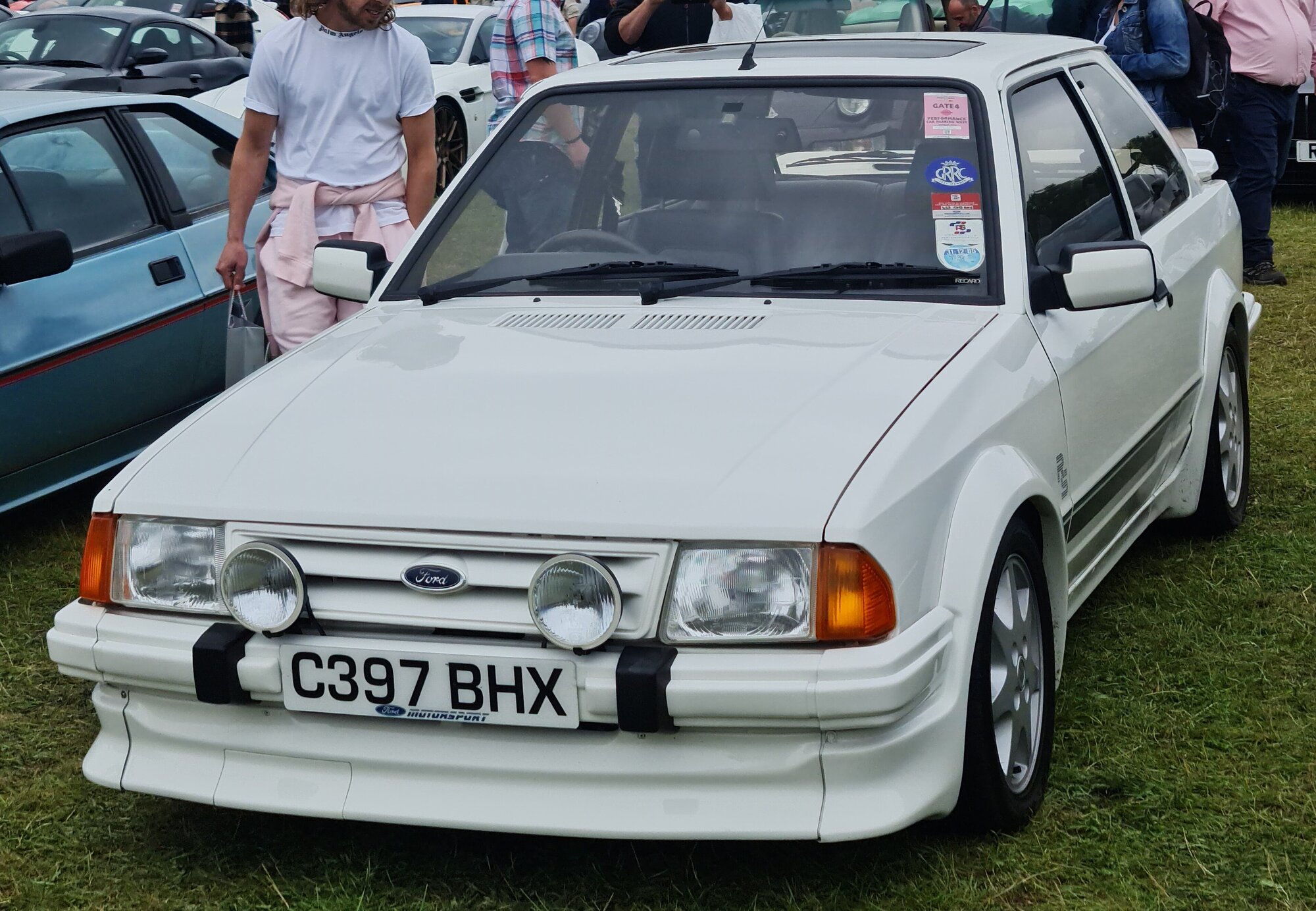
Series 1 or Series 2? It’s the single most-asked question in Ford Escort RS Turbo buying. Every prospective owner reaches the same crossroads: the rarer, rawer Mk3 S1 in Diamond White only, or the more civilised, much-more-numerous Mk4 S2 in every colour Ford offered. After two decades of bodyshop and restoration work on classic Fords at my workshop near Milton Keynes as a classic Ford specialist, I’ve seen the two cars side by side enough times to give you the definitive answer. This is the Ford Escort RS Turbo Series 1 vs Series 2 buyer’s guide — what’s different, what to check, what to pay, and which is right for what you actually want.
A Short History of the Ford Escort RS Turbo
1984: Ford launches the RS Turbo to homologate the Group A rally Escort. The first turbocharged road Ford for the UK market. Mk3 shell, 1.6 CVH with a Garrett T3 turbo, 132 bhp, Diamond White only as a homologation requirement. 8,604 built before the Mk4 facelift in 1986.
1986: Mk4 facelift launches as the Series 2. Same drivetrain, refined chassis tuning, smoother lines, every colour in the Ford palette available. Production continued through to April 1991, totalling 22,108 cars — roughly two and a half times the Series 1 build run.
The Escort Cosworth followed in May 1992 (built by Karmann on a Sierra Cosworth 4×4 floorpan, not on the Mk5 Escort itself). The full chronology is in the complete Ford Escort RS guide.
Ford Escort RS Turbo Series 1 (1984 to 1986) at a Glance
- Engine: 1597cc CVH turbo, Garrett T3, 132 bhp
- 0–60 mph: 8.3 seconds
- Top speed: 127.1 mph
- Production: 8,604 (including Custom Pack)
- Colours: Diamond White only officially — three Panther Black cars were specially commissioned for the Royal Family (one of them Princess Diana’s). See Princess Diana’s RS Turbo story.
- Shell: Mk3, blocky square-cut wheel arch extensions, distinctive front spoiler
- Wheels: RS multi-spoke alloys, 15″
Ford Escort RS Turbo Series 2 (1986 to 1991) at a Glance
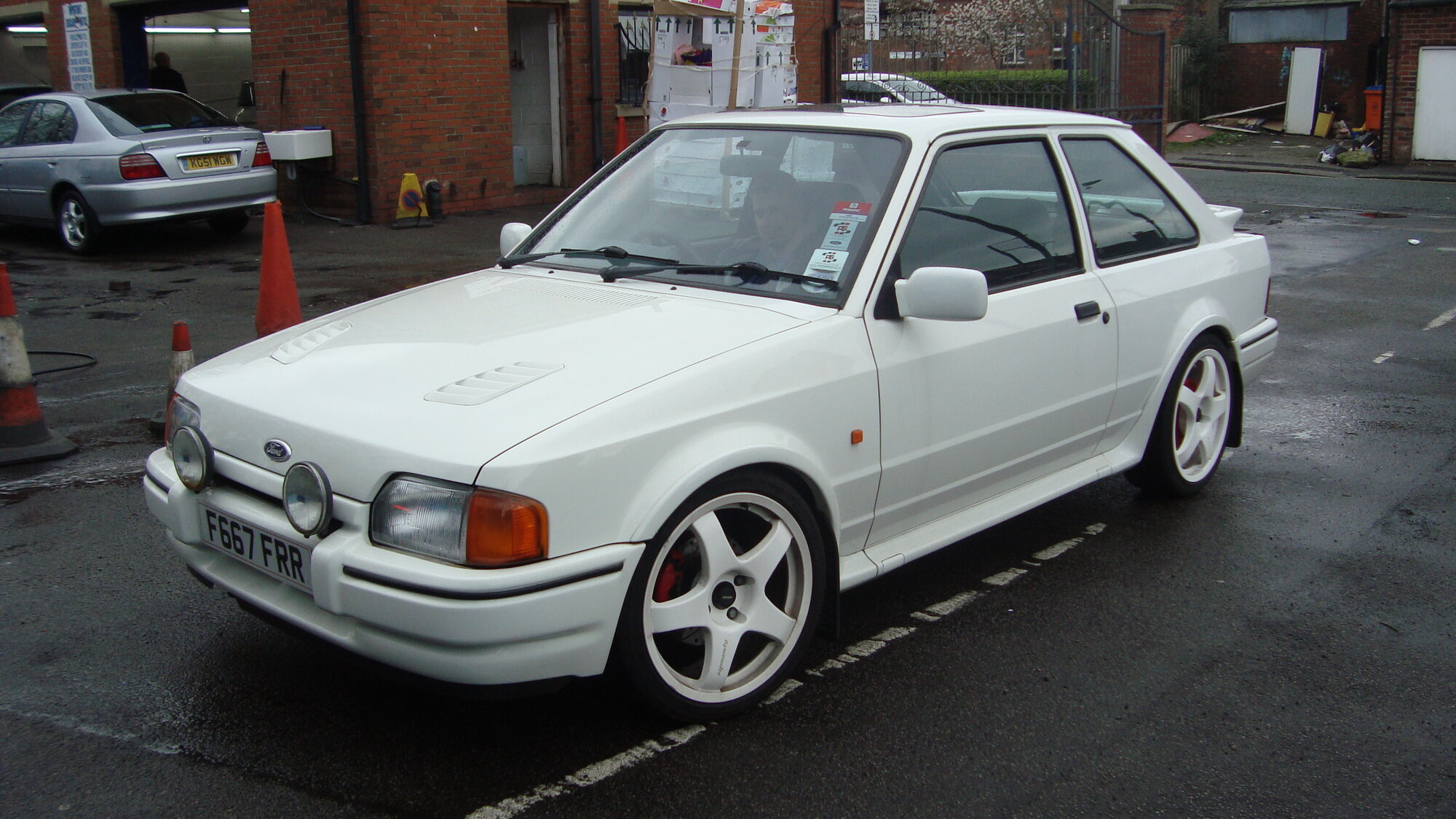
- Engine: 1597cc CVH turbo, Garrett T3, 132 bhp
- 0–60 mph: approximately 8.3 seconds (sources cite 7.9–8.3 across the production run)
- Top speed: around 125 mph
- Production: 22,108
- Colours: all standard Ford palette
- Shell: Mk4 facelift, smoother bumpers, integrated wheel arch lines
- Wheels: revised RS alloy pattern, 15″
- Anti-lock brakes: mechanical ABS fitted from 1989 onwards
How to Tell a Series 1 from a Series 2 at a Glance
- Series 1: square-cut wheel arch extensions, RS multi-spoke alloys, white-only, square Mk3 headlamps and grille, Mk3 dashboard with separate instrumentation pod
- Series 2: smoother bumpers and arch lines, revised alloy pattern, any standard colour, Mk4 facelift bonnet/grille/lights, Mk4 dashboard with integrated cluster
If it’s white, square-cut and Mk3-shaped, it’s a Series 1. If it’s any other colour or has the Mk4 smoother nose, it’s a Series 2. Easy at the kerbside; impossible to fake well at close range because the panels are different stampings.
Driving Differences — What the Press Doesn’t Tell You
I’ve driven both. Properly driven, not just sat in. The contemporary press reviews described the S1 as raw and the S2 as refined; that’s roughly right but the reality is more interesting.
- S1 is rougher round the edges — more on-boost lag, harsher springing, an unmistakable “event” feel when the turbo starts to deliver above 3,500 rpm. The car you have to commit to.
- S2 is calmer, more confidence-inspiring — broader spread of boost, less drama, faster point-to-point in the wet because you trust it. The car you can drive every day without fighting it.
- S1 is closer to a homologation car — it’s what Ford had to build to legalise the rally programme. It feels like a Group A car that’s been gently de-tuned for the road.
- S2 is closer to a hot hatch — Ford had time to civilise the mid-cycle Mk4. It drives like an XR3i with a turbo strapped on, in a good way.
Build Quality and Reliability Differences
- Galvanising — later S2 shells (post-1988) had more galvanised panels than the S1. That helps with structural longevity, but every RS Turbo of either Series still rots in the standard Mk3/Mk4 spots.
- CVH engine quirks — same engine in both. Tappet noise, top-end wear, head-gasket vulnerability. Reliability is about previous owners, not Series.
- Turbo wear — Garrett T3 lives a hard life on these cars. Most have been rebuilt or replaced at least once. £500–£1,000 to rebuild.
- S1s typically need more welding now — older shells, less galvanising, more years of road salt. Most S1 survivors have had at least one round of structural welding.
Where RS Turbos Rust — Series 1 vs Series 2 Differences
The general Mk3/Mk4 Escort rust pattern is in the Where Ford Escorts rust guide. RS Turbo-specific things to add:
- Front bumper mounts — both Series. The moulded plastic bumpers bolt to brackets that rot. £200–£400 per corner. S1 brackets are different shape to S2.
- Rear bumper mounts — same story. £200–£400.
- S1 wheel-arch extensions — the square-cut S1 arches are bolted on. Mud and salt trap behind them. By the time you can see paint bubbles, the arch behind has rotted. £400–£700 per arch.
- S2 wheel-arch extensions — same problem, smoother edges, slightly less salt trapping.
- S1 rear spoiler mounts — water gets under the rear spoiler and rots the bootlid around the mounting holes. £300–£600.
- Sunroof drains — both Series. Block up, water dumps into the floor and inner sills.
- Sills — same three-layer pattern as base Escorts. £2,000–£3,500 a pair properly done.
Trim and Parts Availability
- S1 Recaros — significantly rarer than S2. Original-cloth pattern Recaros are £1,500–£2,500 a pair to retrim. Leather Custom Pack Recaros £2,500–£4,000.
- S2 Recaros — more available, more reproduction options. £800–£1,500 to retrim a pair.
- Dashboard — Mk3 and Mk4 dashboards are different. Mk3 dashes in good condition are getting hard to find. £300–£600 for a salvage one.
- Badges — S1-specific RS Turbo badging is rarer and pricier than S2.
- Wheels — original RS multi-spoke alloys (S1) are £500–£900 each for sound originals. S2 alloys £200–£400 each.
- S1 trim parts generally cost 50 to 100% more than equivalent S2 parts.
Ford Escort RS Turbo Values in 2026 — S1 vs S2
| Condition | Series 1 (Diamond White) | Series 2 |
|---|---|---|
| Project (rotten, runs) | £8,000–£15,000 | £4,000–£8,000 |
| Restorable, drivable | £15,000–£22,000 | £7,000–£12,000 |
| Driver-quality, sorted | £20,000–£35,000 | £10,000–£18,000 |
| Concours, low miles | £35,000–£55,000 | £18,000–£28,000 |
| Custom Pack (extra premium) | +30–50% | +15–25% |
| Princess Diana-spec Panther Black S1 | Significant premium — see dedicated piece | N/A |
The S1 premium is typically 50 to 100% over an equivalent S2. Custom Pack on either car carries additional 15 to 50% premium. The Princess Diana-spec black S1 sits in its own market — see the dedicated Princess Diana RS Turbo piece for that story.
Which Should You Buy? Series 1 or Series 2?
| If you want… | Buy this |
|---|---|
| Investment / collector | S1 Custom Pack — values still climbing, Princess Diana cultural relevance helps every S1 in the market |
| Weekend car / occasional use | S1 if budget allows. S2 if not — the driving experience gap is smaller than the price gap |
| Daily driving or modifying | S2 — don’t molest a rare white S1, buy a £12k S2 and have fun |
| First RS Turbo / learning the platform | S2 — cheaper to make mistakes on, easier to find parts for |
| Show car / Ford Fair lawn | S1 Custom Pack — original Recaros, gauges and alloys, period correctness wins |
| Maximum reward per pound spent | S2 driver — sorted at £14k delivers 90% of the S1 experience for 35% of the money |
The Custom Pack Question
Worth a dedicated mention because Custom Pack is the collector spec on either Series:
- S1 Custom Pack — half-leather Recaros (the seats with the cloth centres), half-leather rear bench, electric front windows, central locking. A substantial share of the 8,604 S1s were Custom Pack — exact factory split isn’t published, so any specific number is an enthusiast estimate. Carries the biggest premium in the S1 market.
- S2 Custom Pack — equivalent leather Recaros and equipment. Less rare than S1 Custom Pack but still desirable. 15 to 25% premium over a standard S2.
Beware the Modified, the Re-shelled and the Relisted
The RS Turbo market has had thirty years for cars to be modified, crashed, re-shelled and washed through multiple owners. Common red flags:
- “This S1 has been restored” — fine if documented. Suspect if the seller can’t say who did what, or when. Restored S1s with paper trails are worth significantly more than restored S1s without.
- Non-matching engine — common on RS Turbos because the CVH wasn’t strong enough for hard tuning. Discount accordingly but doesn’t automatically kill the deal.
- Wrong-colour S1 — any S1 in a colour other than Diamond White needs explaining. The only factory non-white S1s are the three Panther Black Royal Family cars. Repainted cars are common; factory non-white S1s outside those three are vanishingly rare and need documentation.
- Big-power conversions — many S1s have been hybrid-turbo’d, chipped or otherwise modified. Fine if you want a modified car. Bad for collector value.
- “History file” — every RS Turbo should have one. No history is itself a red flag.
Getting a Specialist Eye on Your RS Turbo Purchase
If you’re looking at an RS Turbo and want a second opinion before you commit, I’ll happily look one over. I see them through the workshop regularly and I know exactly where the rust hides, what the wrong-spec trim looks like, and what’s been re-shelled vs original. The bodywork is usually 60% of any RS Turbo project — see Escort restoration costs for what fixing that costs.
Send me photos on WhatsApp and I’ll tell you what you’re looking at. The full Ford Escort RS family is covered in the RS models guide; my own 1998 GTI build is in the case study.